What is Hyaluronidase?
Hyaluronidase is a family of enzymes that catalyze the degradation of hyaluronic acid (HA), a major component of the extracellular matrix. These enzymes break down the glycosidic bonds in hyaluronic acid polymers, reducing the viscosity of the tissue matrix and facilitating the diffusion and absorption of other molecules.
In research, hyaluronidase serves as a critical tool for studying extracellular matrix biology, drug delivery mechanisms, and tissue permeability. It is one of the most widely used enzymes in pharmaceutical research and clinical studies.
Types of Hyaluronidase
| Type | Source | Optimal pH | Key Features |
|---|---|---|---|
| Type I (Hyaluronoglucosaminidase) | Mammalian (testicular) | pH 4.0-4.5 | Endo-beta-N-acetylhexosaminidase; produces tetrasaccharides |
| Type II (Hyaluronoglucuronidase) | Leech, hookworm | pH 6.0-7.0 | Endo-beta-glucuronidase; produces tetrasaccharides and hexasaccharides |
| Type III (Bacterial) | Streptococcus, Staphylococcus | pH 5.0-6.0 | Lyase mechanism; produces disaccharides via beta-elimination |
| PH20 (rHuPH20) | Recombinant human | pH 7.0-7.4 | Soluble form; used in research drug delivery studies |
Mechanism of Action
Hyaluronidase degrades hyaluronic acid through hydrolytic cleavage:
- Substrate Binding: The enzyme binds to the hyaluronic acid polymer chain at specific glycosidic linkages
- Catalytic Hydrolysis: For Types I and II, the enzyme cleaves the beta-1,4-glycosidic bonds between N-acetylglucosamine and glucuronic acid residues through a hydrolysis mechanism
- Product Release: The reaction produces oligosaccharide fragments of varying lengths, reducing the overall molecular weight and viscosity of the HA matrix
- Tissue Effect: The degradation of HA temporarily increases tissue permeability by breaking down the gel-like extracellular matrix barrier
Research Applications
Drug Delivery Research
- Studying subcutaneous drug absorption and dispersion
- Co-formulation studies with monoclonal antibodies and biologics
- Investigating tissue barrier function and permeability
- Developing enhanced delivery systems for large-molecule therapeutics
Extracellular Matrix Biology
- HA metabolism and turnover studies
- Cell migration and invasion assays
- Wound healing and tissue remodeling research
- Tumor microenvironment investigations
Ophthalmology Research
- Vitreous humor dynamics and composition studies
- Intravitreal drug delivery optimization
- Vitreoretinal interface research
Dermatology Research
- Skin hydration and aging mechanism studies
- Dermal filler degradation kinetics
- Transdermal drug delivery enhancement
Handling and Storage
- Store lyophilized enzyme at -20°C
- Reconstitute with sterile PBS or appropriate buffer at pH 6.0-7.0
- Reconstituted enzyme stable for 7-14 days at 2-8°C
- Activity expressed in International Units (IU) per mg
- Avoid repeated freeze-thaw cycles — aliquot upon reconstitution
Quality Specifications — Aarise Healthcare
| Parameter | Specification |
|---|---|
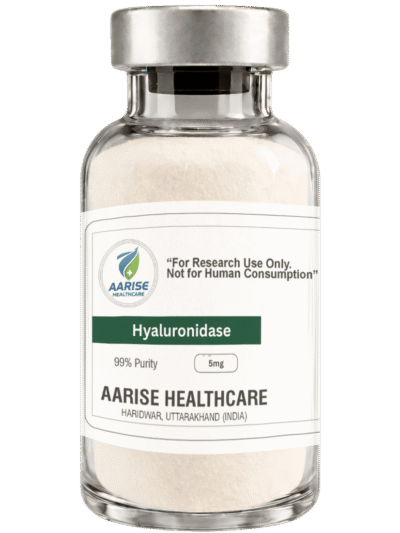
| Purity | ≥99% (HPLC) |
| Activity | ≥300 IU/mg (Type II) |
| Appearance | White to off-white lyophilized powder |
| Endotoxin | <0.1 EU/mg |
| Solubility | Freely soluble in PBS and water |
Aarise Healthcare supplies both Type II Hyaluronidase and standard Hyaluronidase for research applications. Request COA and pricing.
Frequently Asked Questions
What is hyaluronidase used for in research?
Hyaluronidase is used to study extracellular matrix degradation, drug delivery mechanisms, tissue permeability, and HA metabolism. It is an essential tool in drug delivery, dermatology, ophthalmology, and cancer research.
What is the difference between Type I and Type II hyaluronidase?
Type I (mammalian) works optimally at acidic pH (4.0-4.5) and is an N-acetylhexosaminidase. Type II works at near-neutral pH (6.0-7.0) and is a glucuronidase. Type II is often preferred in research due to its activity near physiological pH.
How do I measure hyaluronidase activity?
Activity is typically measured using turbidimetric assays (reduction in HA turbidity) or colorimetric methods (Morgan-Elson reaction for released N-acetylglucosamine). Results are expressed in International Units (IU).
Related Articles
- Tirzepatide Research Compound — Mechanism, GLP-1/GIP Dual Agonism & Study Applications
- Semaglutide Research Compound — GLP-1 Agonist Mechanism, Applications & Purity Guide
- AOD-9604 Peptide Research Guide — Mechanism, Studies & Applications
- DSIP (Delta Sleep-Inducing Peptide) Research Guide — Mechanism, Sleep Studies & Applications
Also from Aarise Group: